Marie Kondo Your Mind: A Guide to Internal Simplification
“In the short term, distractions can keep us from doing the things we want to do. In the longer term, however, they can accumulate and keep us from living the lives we want to live…”
- Jenny Odell in “How to Do Nothing”
The other day, I ate lunch at a quiet restaurant. The only noises were kitchen sounds and other customers talking to one another. Since music is playing in nearly every public space, this made an impression (as did the pad thai). Agreeable pop hits are even streaming through parking decks nowadays, not to mention the TVs in waiting rooms and airline terminals. And if that’s not enough, our phones are always at the ready with real-time anything.
Of course, it is all more than enough. I could Google “average media consumption daily” to quantify how bombarded we are with information today, but I won’t because this is old news. Shortly after 50 AD, the philosopher Epictetus complained about information overload, too. It makes you wonder if even our very distant ancestors also felt like they needed a way to unplug from hunting and gathering.
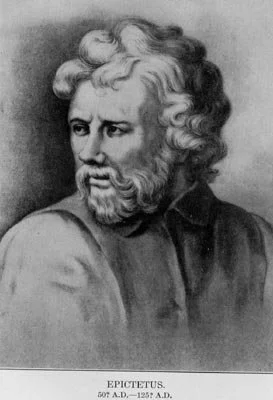
This is Epectitus
He had great hair, no?
We allow most of this bombardment. Epictetus chose differently and helped start Stoicism. I'm trying to do something similar: choose what deserves my attention and let go of what doesn't. This isn't about running away from modern life—it's about engaging with it on purpose.
This filtering is what I mean by internal simplification. It goes deeper than decluttering your closet or living in a van. External simplification can help, but it's not enough. Real simplification means choosing to pay attention only to what supports what you value, making space in your mind for what actually matters.
This is hard—not because filtering is complicated, but because you have to know what matters first.
Filtering is key to being present. I call this practice internal simplification — a deeper form of minimalism that goes beyond the physical decluttering that's become so popular. You've encountered external approaches like capsule wardrobes, Marie Kondo's methods, or #vanlife. While these can create helpful conditions for presence, they are mostly for show. True internal simplification is about choosing to pay attention only to what supports your values and goals, making space in your mind for what matters most.
This isn’t easy, not because the “doing” of simplification is difficult, but because deciding what matters is. You cannot filter out what you don’t want until you know what you do want and why.
Pay attention to what you value
Sharon Lebell's interpretation of Epictetus in The Art of Living offers this kick in the pants: "You become what you give your attention to." If we don't choose what we expose ourselves to, someone else will “and their motives may not be the highest.”
No matter what type of content it serves, your digital platform of choice is not motivated by the development of your well-being but the consistency of your attention. The goal is profit-making, not meaning-making. Even if the content is helpful, the aim is to make it easy for you to consume more than you need to as often as possible. And that’s not all; it gets worse.
The immediacy of it — and especially social media’s default mode of everything-is-always-a-crisis — results in what Jenny Odell calls “the fearful present.” In her book How to Do Nothing she discusses how our constant so-called “awareness” makes us anxious, not present. We think we have a better grasp on what’s going on when we check social media or our favorite news app, but this is a false sense of certainty and control. Knowing what is going on does not equal understanding how it may or may not affect us or those we love.
What we can be certain about is what we value. Without that filter, everything seems equally important. Like trying to hear every conversation in a crowded room—you end up hearing nothing clearly.
Start by identifying what you actually value. Then you can filter your attention and create space for real presence.
Choose what truly matters (to you)
Where to start?
Follow what excites you within what you control…
Epictetus said to focus only on what we control: our judgments, intentions, responses. Everything else — even our health, even (gasp!) aging — falls outside our complete control.
But there's another filter: what naturally excites you. What makes you lose track of time? What pulls you in even when you're tired? That excitement points toward your real values.
If something doesn't excite you, ask: is this actually my value, or just something I think I should value? Real values pull you forward. They don't need willpower.
…so we can take in what’s around us…
Annie Dillard took daily walks to practice patient observation. She wrote about the tree-falling-in-the-forest question: if no one's there to hear it, does it make a sound? Her answer: 'Beauty and grace are performed whether or not we will or sense them. The least we can do is try to be there.'
Being there isn't passive. She says to 'really see it':
The whole show has been on fire from the word go. I come down to the water to cool my eyes. But everywhere I look I see fire; that which isn’t flint is tinder, and the whole world sparks and flames.
Filtering creates the emptiness that makes this possible. By removing what doesn't matter, we create capacity for what does. Not a void but a vessel to be filled.
…and be present for it.
Rebecca Solnit writes about being 'lost' in two ways. One: the familiar disappears. Two: the unfamiliar appears. Both mean letting go of control we never really had.
She aims to be 'rich in loss' or rich in noticing what's new. This requires the same inner space Dillard describes: room to actually see what's in front of you instead of what you expect to see.
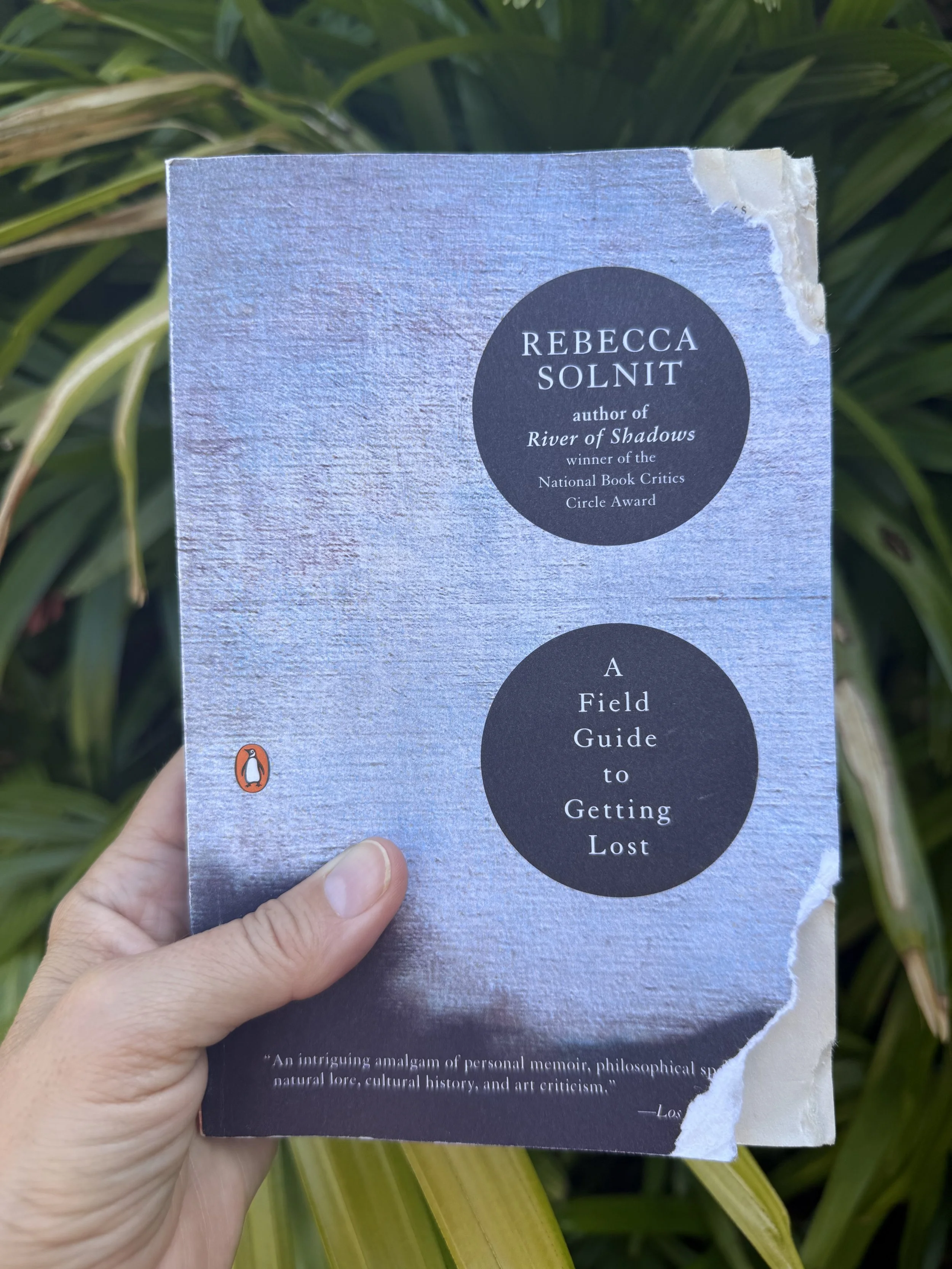
My copy of A Field Guide to Getting Lost
Though half-eaten by a dog I loved dearly, it reads the same. Plus, I like seeing his little teeth marks.
RIP, Otis.
This truth, that presence requires us to release our anxious grip on certainty and instead open ourselves to what's actually here, is where the ancient wisdom of Epictetus meets the modern insights of Solnit and Dillard. This openness becomes possible when our values—especially what naturally excites and draws us—act as our filter, allowing us to let go of everything else.
Create rituals to practice presence
Think of rituals as structures inside of which you are more able to be intentionally present.
Rick Rubin talks about this in The Creative Act, how ritual creates a container for creativity by eliminating decision fatigue. Dillard demonstrates it too. Her regular walks weren't about efficiency, but about creating familiar ground where she could focus entirely on observation. The repeated actions of rituals can become doorways to presence. Some of mine have been writing in my journal before going to bed, listening to a book when doing dishes, walking the dog each morning, setting the table for dinner with placemats, dishes, napkins, even a centerpiece (and even if I'm the only one eating).
The power of ritual lies in its intentionality. While routines run on autopilot, rituals demand our attention. Making a nice cup of morning coffee can be mindless routine or mindful ritual—the difference isn't in the action but in the presence we bring to it.
Effective rituals have three elements:
Protected space — Arranging physical or temporal boundaries that signal "this is different"
Intentional attention — Choosing where to focus and what to filter
Consistent practice — Showing up regularly enough for the ritual to become a natural gateway to presence
The goal isn't to turn every activity into a ritual, which would be exhausting and counterproductive. Instead, choose key moments that align with your values and deserve your full presence. Think of ritual as a practice of recognition—both of what deserves your attention and what doesn't.
These become anchors in your day, reliable signposts on the path back to presence when the world threatens to overwhelm. When you establish clear rituals around what matters, distractions become easier to identify and release.
The paradox of less
When you filter based on what actually excites you and build rituals around it, something strange happens: you end up with more, not less.
Your experience intensifies. Instead of spreading attention across a thousand things, you concentrate it on a few vital ones. Full attention to what's actually in front of you.
Meaning emerges on its own. Stop hunting for it in the noise. Just pay attention to what draws you. Patterns appear. This is what Dillard found on her walks, what any practice of presence reveals: meaning needs space, not effort.
Emptiness creates fullness. (Sounds corny, but it's true.) The space you clear by saying no becomes a vessel that fills naturally. Conversations have insight because you're actually listening. Nature is obvious you're looking. Even being alone transforms from loneliness to possibility.
Notice what excites you. Clear space for it. Repeat.